
Prime rib has become a yearly staple for my family for Christmas, and over the years I've perfected the BEST slow roasted prime rib in the oven.
Everyone who's had prime rib at my house agrees that it's the best prime rib they've ever had.
And the good news? It's surprisingly simple!
With a basic salt and pepper rub and a low, slow roast in the oven followed by searing (also in the oven!) this reverse sear prime rib is an absolute showstopper - that happens to be much easier than any guest would expect!
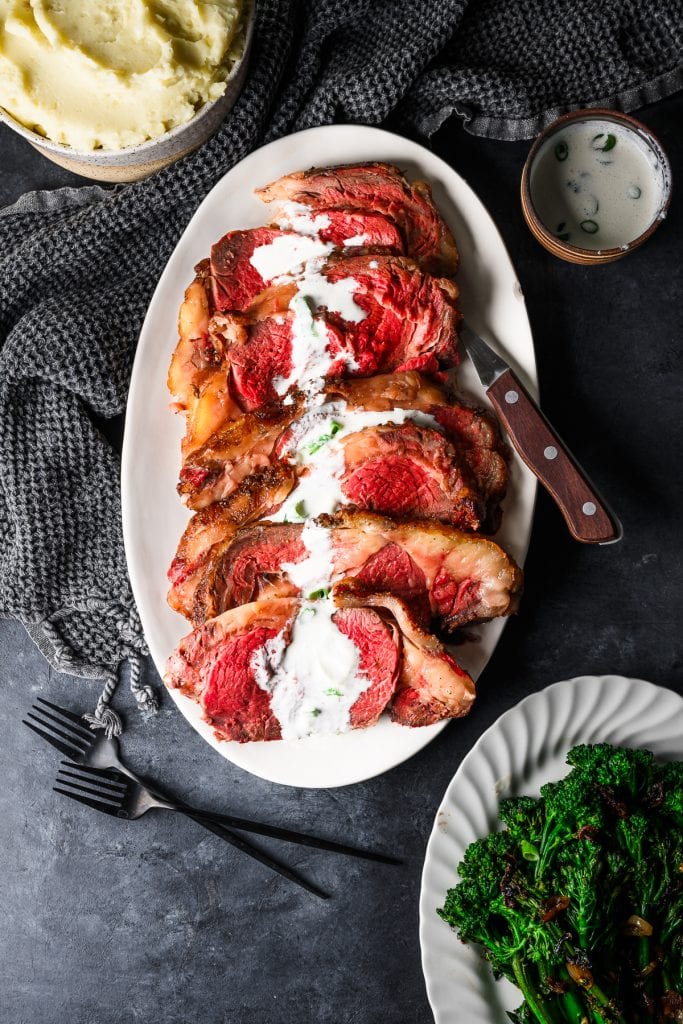
Reverse seared prime rib is the best
That's right: the best way to make prime rib is the reverse sear method. And J. Kenji López-Alt at Serious Eats proved it.
I learned how to make prime rib from this article on Serious Eats, as well as why reverse searing in the oven is the way to go.
Let's face it, without that article, I wouldn't have even TRIED making prime rib, for fear that I would spend so much money on prime rib just to ruin it.
This recipe is strongly inspired by that original recipe on Serious Eats.
Let's dive in to the knitty gritty of reverse sear oven roasted prime rib!
Jump to:
- Reverse seared prime rib is the best
- Want a summary?
- Ingredients needed for prime rib
- How to make the most incredible slow roasted prime rib
- Ideal internal temperature for prime rib
- What to do with leftover prime rib
- How to reheat oven roasted prime rib
- Troubleshooting and FAQs
- What to serve with reverse seared prime rib
- Want to take it up a notch?
- 📖 Recipe
Want a summary?
Ask AI to summarize or ask a question about this specific recipe!
Disclosure: these buttons are meant to be helpful but I am not responsible for how AI answers.
Ingredients needed for prime rib
We're going to keep things super simple for this recipe!
I firmly believe that the higher-quality cuts of beef don't need lots of sauces, spices, marinades, etc. to make them incredible.
So for this recipe, all you need are prime rib, kosher salt, and black pepper.
How to choose prime rib
The first choice to make is whether you want to cook a boneless or bone-in prime rib roast.
Generally I don't shy away from bone-in roasts or steaks (bones can impart more flavor and act as a buffer to prevent overcooking), but I've only ever made boneless prime rib roasts because of the ease of slicing. The choice is yours!
As for the size of the roast, the general rule of thumb is 1 pound per person for a boneless roast. (You'll need more per person for a bone-in roast, since the bone accounts for some of the weight.)
I highly recommend going to a local butcher for prime rib. They should be able to cut the size you need as well as trim down any excess fat for you and tie it.
Why tie a roast? The most straightforward benefit is more even cooking, reducing the risk of overcooking certain areas. So definitely request that your butcher tie the prime rib roast for you, too.
Otherwise, the Thermoworks website has a great tutorial for trimming down and tyeing a prime rib.

How to make the most incredible slow roasted prime rib
The beauty of this recipe is its simplicity (even if it does take a while).
All you need is an oven, the three ingredients listed above, a baking sheet, wire rack, and time.
Dry Brine the Prime Rib:
Ideally, you'll start the day before. Most roasted meats are better when brined, and my go-to is dry brining.
To dry brine, you'll rub the prime rib with kosher salt and ground black pepper. Then pop the prime rib, on a plate but uncovered, in the fridge until you're ready to start cooking.
Roast, Low and Slow:
Preheat the oven to 250 degrees F, or as low as you can get it if your oven doesn't go down to 250.
Place the prime rib either in a V-rack over a roaster OR my preferred method, on a wire rack over a rimmed baking sheet. (It's my preferred method because I don't have to own a V-rack!)
Make sure you use a wire rack - if you would place the roast directly on the baking sheet, the bottom will cook through well before the rest of the roast, and the goal is even doneness throughout the roast. So it needs to be elevated with the help of a wire rack or V-rack!
From there, you'll roast the prime rib, low and slow, for 4+ hours, until an instant read thermometer reads 120-125 degrees F for medium-rare, 125-130 degrees F for medium, or 130-135 degrees F for medium well. Personally, I like a medium-rare prime rib!
Depending on the size of your prime rib, cook time may be a little shorter or longer.
Let the Roast Rest:
Take the prime rib out of the oven and tent loosely with aluminum foil.
Let the roast rest for AT LEAST 30 minutes. During that time, crank the oven heat up to 500 degrees F.
Sear the Prime Rib (in the Oven!):
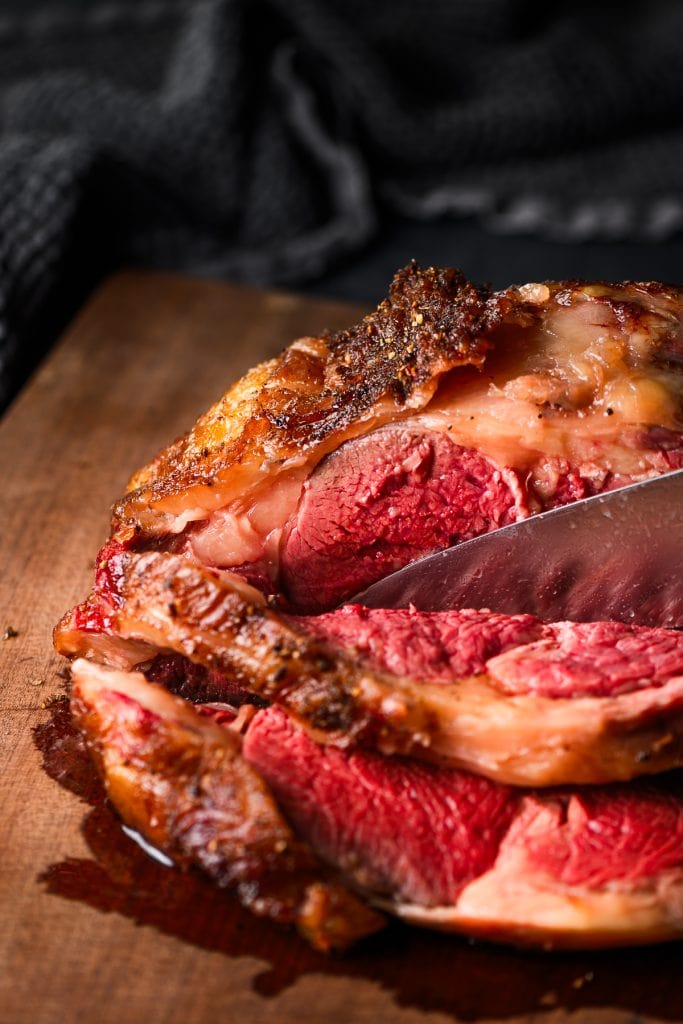
Here's where the reverse sear magic comes in! Uncover the prime rib and put back in the hot oven for about 10 minutes.
This hot stint in the oven creates that crisped, crackling crust that makes prime rib so ridiculously delicious. Definitely don't skip this step!
Once the prime rib comes out of the oven this second time, it's ready to carve immediately and serve. Since you rested the meat before the sear, a second resting it's necessary.
Ideal internal temperature for prime rib
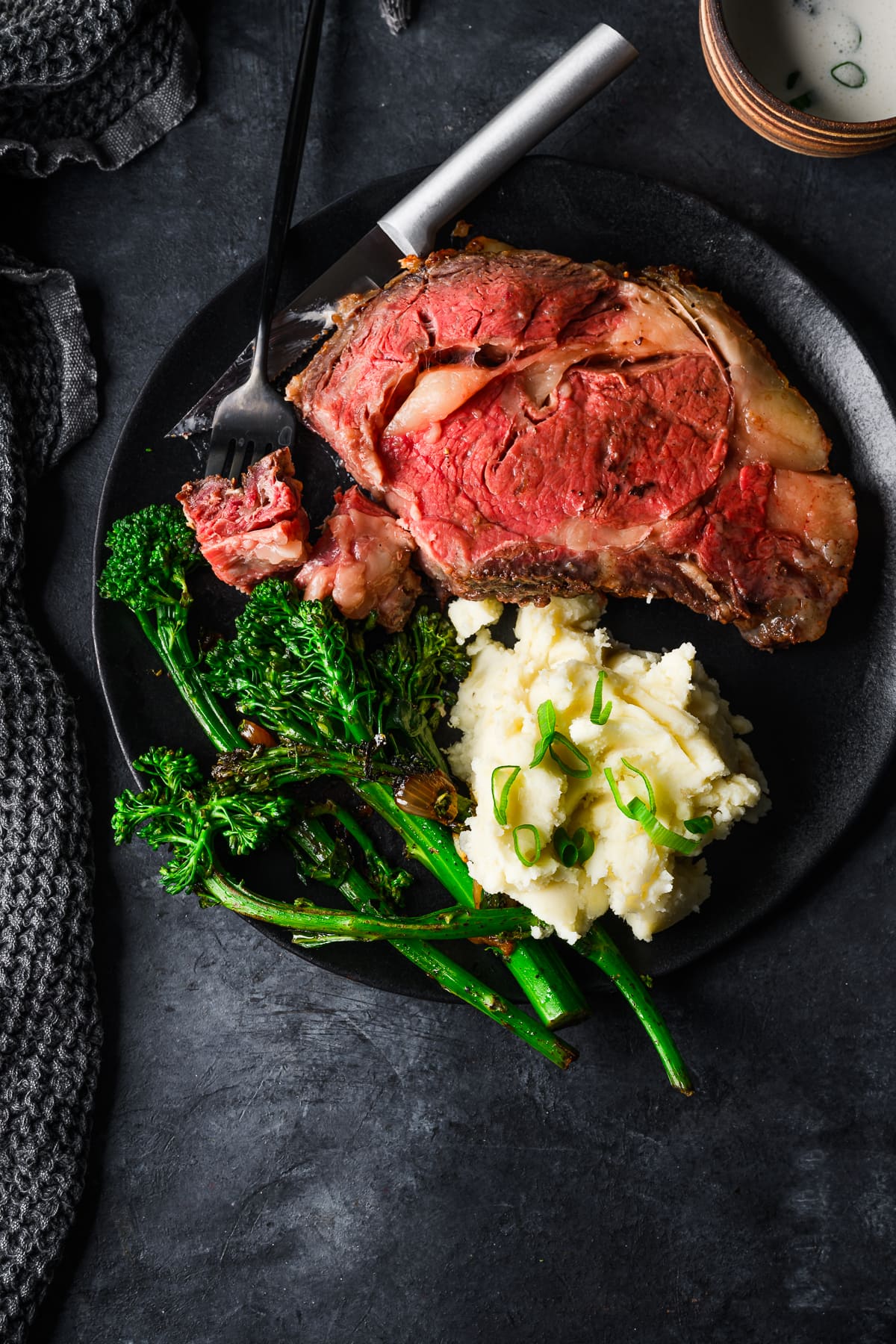
Here are the temperatures you should be shooting for while roasting prime rib:
- Medium Rare: 120-125 degrees F
- Medium: 125-130 degrees F
- Medium Well: 130-135 degrees F
My favorite is medium rare or medium prime rib. I typically start checking the temp of the roast at 3 hours. Once it's between 120 and 125 degrees F, I'll pull the prime rib out of the oven to rest.
I highly recommend an instant-read thermometer for your prime rib. I have a Thermapen - excellent investment!
It's long enough to pierce to the middle of the roast and is TRULY instant.
In-oven thermometers that you stick in the roast and leave in as it cooks can sometimes skew warm, so an instant-read thermometer is the way to go!
What to do with leftover prime rib
If you've ended up with leftovers, I've got a few ideas for using it up!
- Simply reheat! Use the instructions below for the best way to reheat the leftovers.
- Slice thin and use for french dip sandwiches or sliders.
- Serve the next morning for a steak and eggs breakfast.
- Chop up and use for tacos.

How to reheat oven roasted prime rib
The last time I made this for my family, we had lots of leftovers. The next morning my dad raided the fridge for another serving of prime rib for breakfast. I asked how he was going to reheat it, and he shrugged and said, "the microwave."
I'm telling you right now: do NOT reheat prime rib in the microwave.
You've spent way too much money on this piece of meat to nuke it in the microwave and ruin the best dang prime rib you've ever had.
Instead, turn the oven on. 350 degrees F works just fine.
Place the prime rib in an oven-safe dish (I just use my cast iron) and put in the oven for 8-10 minutes, or until the prime rib is warm and the fat is no longer hardened with cold. Eat immediately.

Troubleshooting and FAQs
Have some questions or ran into a problem? These answers should help.
Nope! Roasting uncovered actually helps the meat turn out well, with the signature prime rib crust and evenly-cooked meat.
The prime rib simply won't develop the "crust" if you cover it.
On a side note, I suspect previous generations (at least in the Midwest) simply covered any meat with aluminum foil or plopped it in a roasting pan and cooked it until it was literally falling apart. That works for pulled pork. Not so much prime rib.
If you check the temp on your roast and find it reached your target temperature earlier than expected, take it out to rest.
Tent loosely in foil, and leave it to rest for up to 2 hours. When you're close to when you're ready to eat, NOW crank up the oven to 500 degrees and finish up with the reverse sear.
Its stint in the oven at 500 serves two purposes in this case: it reheats the roast without overcooking AND creates that crackly, crispy crust. Slice and serve right after it comes out of the oven from the sear, and your guests will be none the wiser!
I really don't recommend this, because part of the magic here is cooking the prime rib roast slowly, at a low temperature, so that it all cooks evenly and the edges of the roast aren't overdone.
Ideally, a prime rib roast should be pink in the middle from edge to edge, with a minimal brownish-gray ring on the outside.
Plus, the low and slow cooking temp gives plenty of time for the tendon and fats in a wonderfully-marbled prime rib roast to melt down.
What to serve with reverse seared prime rib
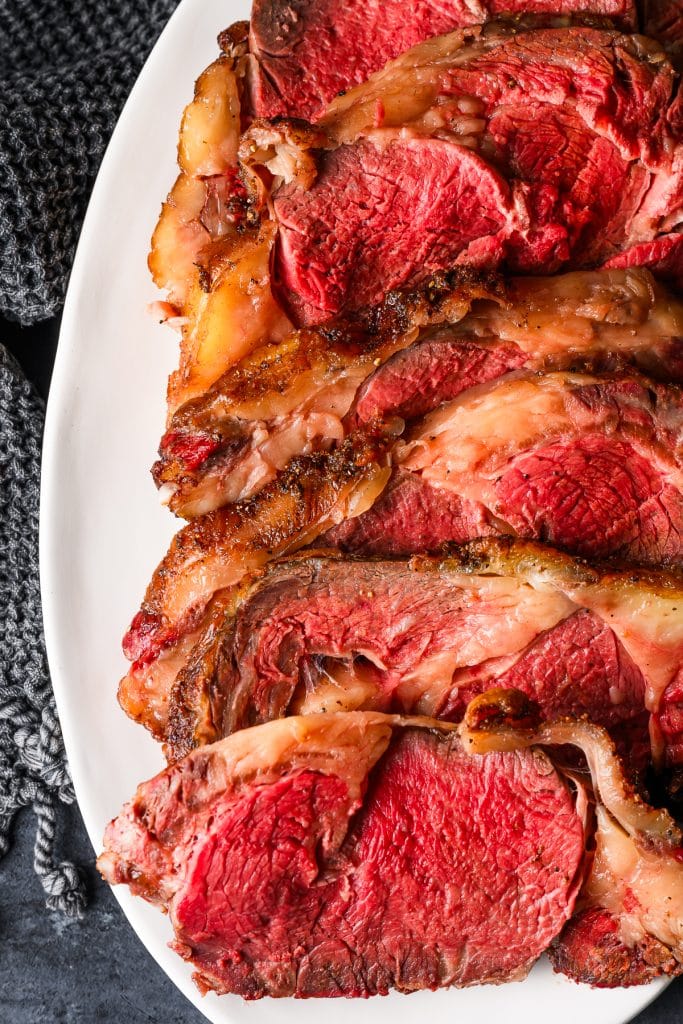
Prime rib is a rich, substantial centerpoint - so I recommend relatively light, simple side dishes.
Roasted veggies are a great gluten free side dish. For the photos, I whipped up some sautéed broccolini, mashed potatoes, and a simple horseradish sauce. Another favorite side is Roasted Maple Bacon Asparagus - it's perfect for holiday meals!
Below are some of my other recommendations that would go great with this recipe!


Want to take it up a notch?
Try smoked prime rib on a pellet grill. The method is the same - still ridiculously easy - and the flavor is out of this world!
Print📖 Recipe
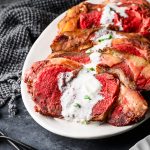
Slow Roasted Reverse Sear Prime Rib (Oven)
- Prep Time: 10 minutes
- Cook Time: 4.5 hours
- Total Time: 0 hours
- Yield: 8 servings 1x
- Category: Main Dish
- Method: Roasted
- Cuisine: American
- Diet: Gluten Free
Description
This slow roasted prime rib will be the best prime rib you've ever had - and it's basically foolproof!
Ingredients
- 1 prime rib roast (boneless OR bone-in), 8 pounds
- 1 tablespoon kosher salt (plus more as needed)
- 1 tablespoon fresh ground black pepper (plus more as needed)
Instructions
- (Optional) At least 1 day in advance, season the prime rib generously on all sides with kosher salt and pepper. Place in the fridge uncovered until ready to roast.
- Preheat the oven to 250 degrees F and adjust oven racks so the top rack is in the center of the oven. If you were unable to season the prime rib in advance, do so now. Place the roast, fat cap up, on a V-rack set in a large roasting pan OR (my method) on a wire rack on a rimmed baking sheet. Place in the center of the oven and cook for 3 ½ to 4 hours, until the center of the roast reaches your desired doneness: 120 degrees F for medium rare, 125 degrees F for medium, or 130 degrees F for medium well.
- Remove the prime rib from the oven. Loosely tent with aluminum foil to keep warm, allowing the roast to rest for AT LEAST 30 minutes and up to 2 hours. Meanwhile, turn the oven up to the highest possible temperature, usually 500 degrees F.
- Remove the foil and place the prime rib roast back into the oven. Roast for 8 to 10 minutes, until the exterior is well-browned and crisp. Remove from oven and transfer to a cutting board. Carve and serve immediately.
Notes
Have a smaller or larger prime rib roast? You can still use this method, just adjust the cooking time as needed! You'll need about 30 minutes per pound, but make sure you start checking the temperature an hour before you're expecting it to be done.
Chelsea Joy says
The best prime rib I've ever had! My dad consistently tells me no other prime rib comes close.